The finding
Homestead Woolen Mill, Swanzey, New Hampshire.
Basis for this status: Identification supplied on 20 October 2026 by Katharine (Kathy) Schillemat of the Historical Society of Cheshire County, which reports holding a duplicate and additional views. Accepted here as a repository identification; those holdings have not been independently inspected.
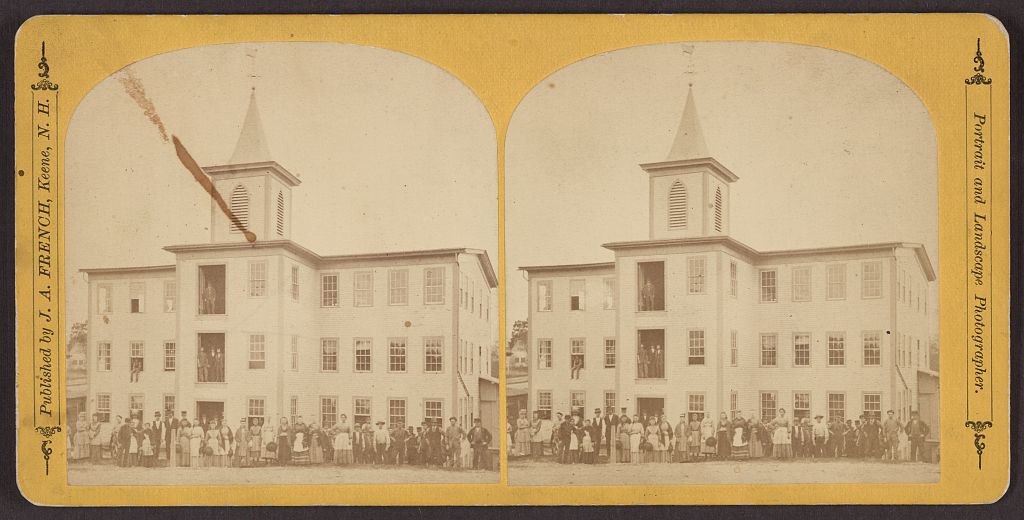
People line the front of a long, three-story building. Others look out from openings beneath its central tower. The Library of Congress catalogued this stereograph as [Unidentified building, possibly a mill]. There is plenty to look at, but no name for the place or the people.
On 20 October 2026, Katharine (Kathy) Schillemat of the Historical Society of Cheshire County supplied a name: Homestead Woolen Mill, Swanzey, New Hampshire. The identification belongs to Kathy and HSCC. It gives the search a location, while leaving the gathering in front of the mill unexplained.
A name from Swanzey
The card’s imprint names J. A. French of Keene, New Hampshire. Keene is where the photograph was published; it does not place the building there. Swanzey comes from Schillemat’s identification.
HSCC reports holding a duplicate of this photograph and additional views of the mill. That is the basis for accepting its identification here. The duplicate, accession record and additional views have not been independently inspected for this report. Until those materials can be compared, the society’s response supplies the name; a visual match remains to be documented.
French’s photograph offers several features to compare: the long facade, repeated windows, projecting central bay and tower. A second view matching that arrangement could show how this block fitted into the mill site, and whether it changed over time.
What was on the back?
A pencilled name or date on the reverse might have answered questions the picture could not. In her reply of 19 October 2026, Michelle L. Smiley, Curator of Photography at the Library of Congress, reported that she had physically examined the card and found no information on its reverse. No further dating evidence accompanied the item.
The Library’s public description gives an approximate date of circa 1870. Smiley’s check supplied nothing to narrow it. That date remains provisional; her report does not independently identify the building.
Three prints of one later photograph
Looking for another view produced a useful disappointment. Three dealer scans (first, second, third) reproduced the same later Homestead photograph in different prints or colour treatments. Three listings had yielded one view. Its later industrial configuration did not establish a match to the block in French’s picture.
The recorded comparison also covered twenty-four additional images in the New Hampshire Historical Society’s second and third Swanzey galleries. None supplied a captioned matching view. That search covered those images, not the repositories’ entire physical holdings, and does not contradict HSCC’s identification.
Earlier readers of the LOC Flickr post had suggested other building types and architectural comparisons. The name came from HSCC’s response, rather than those resemblances.
The people outside the mill
The figures appear to have assembled for the photograph. Who were they, and what brought them together? Their presence is one of the most striking things about the picture, but it does not establish their occupations or the occasion.
There are questions about the building, too. The photographed block’s construction date and original purpose have not been separately established. Nor does identifying the site settle the precise company name in use when French made this exposure.
A labelled view of the same block, a dated print, or a contemporary account of the gathering could take the investigation further. If you have one, send the source and its reference. The public research notes set out the remaining checks, including inspection of HSCC’s reported holdings.
The identification has been submitted to LOC for consideration. No catalogue amendment has been confirmed.
Sources and credit
- LOC catalogue record and persistent digital resource.
- LOC’s Flickr description and discussion, checked 20 October 2026. The main catalogue could not be accessed during that check; the Library’s Flickr description supplied the public metadata.
- Identification: Katharine (Kathy) Schillemat, Office Manager, Historical Society of Cheshire County, correspondence of 20 October 2026.
- Physical-card check: Michelle L. Smiley, Curator of Photography, Library of Congress, reply of 19 October 2026. These repository responses are summarized; full private exchanges are not published.
- Photograph: J. A. French; Library of Congress, Prints and Photographs Division, LOT 13696, no. 9. The Library states “No known restrictions on publication.” The complete web JPEG is shown without generated restoration. Contributor credit does not imply endorsement of this blog.

Dated updates
20 October 2026, initial draft: Prepared from the accepted HSCC identification and LOC’s public description. Circa 1870 remained provisional; the duplicate, building history and catalogue outcome remained open checks. The site had not yet been published.
20 October 2026, prepublication update: The original case records and preserved repository correspondence were recovered and checked. Added the reverse check reported in Smiley’s 19 October reply and the unsuccessful image comparisons.
20 October 2026, publication: First public release on The Uncaptioned Past.
20 October 2026, copy edit: Reorganized the report around the repository replies and image comparisons; removed repeated qualifications and clarified the earlier update entries. Identification, credits, date limits and open questions are unchanged.
A clue to add?
A named source, a dated plan, another view: small pieces can change the picture.
Contribute evidence