Where the case stands
Richard H. Johnston of Company L, 3rd Iowa Cavalry, probably wrote the notebook’s main narrative.
Basis for this status: The diary’s unusual hospital assignment matches Johnston’s 1887 biography. Separate census, birth-index and pension-card evidence supports the family comparison with Frances Burns, though the diary never gives Frankie’s full name. The named hospital detail still rests on the later biography; a wartime order or authenticated handwriting could test the attribution more directly.
On January 9, 1864, a soldier in Arkansas dreamed of returning home from the war. In the dream, he stopped for supper at the house of “Wm Burns,” went to a party with Frankie, and talked with her about their future. They agreed to “splice teams.” He wanted to save the account to read again after he returned home.
The notebook survives at the Butler Center for Arkansas Studies, Central Arkansas Library System, as the 3rd Iowa Cavalry diary. The repository description leaves its writer unidentified.
A cavalryman in an infantry hospital
The writer visited Company L men and wrote about comrades whose names appear in the 3rd Iowa Cavalry’s roster. His hospital work, though, was with the 32nd Iowa Infantry.
On November 13, 1863, he described a conversation with “Doc Biam” about becoming a hospital steward. Four days later, he recorded that he had been detailed to act as “H.S.” for the 32nd Iowa Infantry. He went on to write about medicines, hospital registers and requisitions.
An 1863 hospital-steward manual describes soldiers detailed as acting stewards. John Scott’s later history of the 32nd Iowa names Assistant Surgeon Philander Byam with its detached companies, making him a likely match for “Biam.”
The missed biography
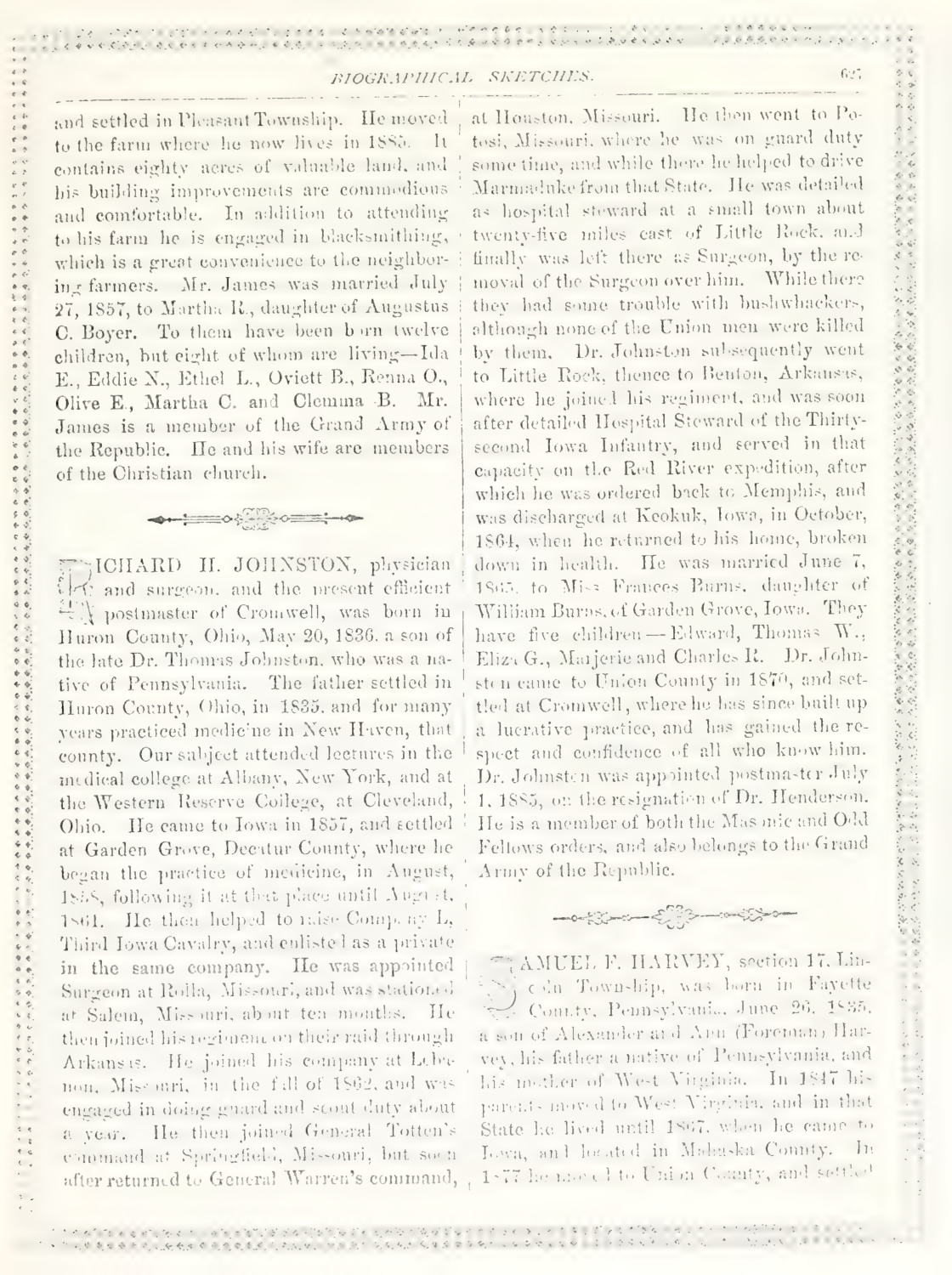
Richard H. Johnston, an Iowa physician, had an entry in the 1887 Biographical and Historical Record of Ringgold and Union Counties, Iowa. The book was already in the research files, but a search of its machine-readable text had missed his name. His biography starts near the bottom of the left column on page 627 and continues at the top of the right.
It follows Johnston from the 3rd Iowa Cavalry to Little Rock and Benton, where he was “detailed Hospital Steward of the Thirty-second Iowa Infantry.”
The same entry reports that Johnston married Frances Burns on June 7, 1865, and names her father as William Burns of Garden Grove, Iowa.
On December 26, the diarist had recorded writing to “Miss Frankie B.” A fortnight later, he dreamed of supper at “Wm Burns” and a party with Frankie. Frances Burns is a plausible match for Frankie, and William for “Wm Burns,” though the diary gives only those shorter names and no relationship between them.
Johnston in the Iowa records
An 1886 Iowa veterans’ list names Richard H. Johnson of Cromwell, a bugler in Company L of the Third Cavalry. The military roster lists Richard H. Johnston of Garden Grove in the same company, enlisted as a bugler in August 1861.
An 1876 Cromwell directory uses both Johnson and Johnston for the physician, so the spelling varied in print. Census pages place him in medical practice at Garden Grove in 1860, then at Cromwell with Frances and children in 1870 and 1880. The 1880 census explicitly identifies Frances as his wife.
The Burns family also appears in separate records. In Garden Grove’s 1860 census, William Burns’s household includes a fourteen-year-old transcribed as Frances S. Burns, born in Ohio. The age and birthplace fit the Frances S. whom the 1880 census calls Johnston’s wife, although the earlier schedule marks the entry male.
FamilySearch’s index to their son Arthur Matt’s 1890 birth names his parents as Richard Hargrave Johnston and Frances Susannah Burns. Johnston’s hospital detail and the exact June 7 marriage date still come from the county biography.
Why the attribution remains probable
The biography appeared more than twenty years after the war, and we do not know who supplied its account. It gives October 1864 for Johnston’s discharge, where the military roster gives September 19, 1864, and places his arrival in Union County in 1870, a year later than the directory. It also calls him a surgeon; we have yet to find a commissioned appointment to go with that description.
Johnston remains the probable author of the main narrative. The volume also holds accounts, prescriptions, verses and inscriptions that may include other people’s writing, so his proposed authorship need not extend to every page.
We are still looking for an authenticated letter to compare with the handwriting, or the wartime order naming his hospital detail. Either would let us test the attribution more directly than the later biography allows.
A federal pension index card points to another place to look. It names Richard H. Johnston of Company L, 3rd Iowa Cavalry, and his widow, Frances S. Johnston, with applications filed in 1880 and 1898. Those application files may preserve signatures or marriage evidence; we have inspected the index card, but have yet to read the files it points to.
Another book at Vicksburg
On February 9, 1864, the writer reached Vicksburg and recorded his intention to close this book and begin another. If that next notebook survives, we have yet to find it.
If the writer was Johnston, the later censuses place him back in Iowa with Frances and their children.
Do you know of another notebook, a signed letter or a hospital record naming Johnston? Send the source and its reference. The research notes give the full record comparisons and unresolved readings.
Sources and credit
- Manuscript: Butler Center for Arkansas Studies, Central Arkansas Library System, 3rd Iowa Cavalry diary, BC.MSS.11.24. Dream, image 278; hospital detail, image 257; letter to Frankie, image 274; ending, image 298. Image IDs identify digital views, often of two page faces.
- Named biography: Biographical and Historical Record of Ringgold and Union Counties, Iowa, vol. 2 (Lewis Publishing Company, 1887), printed p. 627, PDF p. 507. Source for the named hospital detail and the reported June 7, 1865 marriage date.
- Military and residence records: Iowa Roster and Record, vol. 4, p. 533; Alexander’s List of Ex-Soldiers, Sailors and Marines Living in Iowa (1886), p. 184; Colby’s Illustrated Centennial Sketches, Map and Directory of Union County (1876), p. 104.
- Family evidence: 1860 Burns household, manuscript p. 177 / PDF p. 180; Nancee (McMurtrey) Siefert’s IAGenWeb transcription; FamilySearch birth index, Arthur Matt Johnston, 1890, original image unavailable in that viewer; and NARA pension index card, T288, Richard H. Johnston, via FamilySearch. The underlying pension applications have not been inspected.
- Medical context: Woodward’s Hospital Steward’s Manual (1863), p. 19; Scott’s Story of the Thirty-second Iowa Infantry (1896), p. 397. Exact census locators and source limits are in the notes.
Transcriptions retain the adopted “Wm Burns” reading; the earlier Burns/Berns disagreement is preserved in the research notes. Repository credit does not imply endorsement of the attribution.
A clue to add?
A named source, a dated plan, another view: small pieces can change the picture.
Contribute evidence